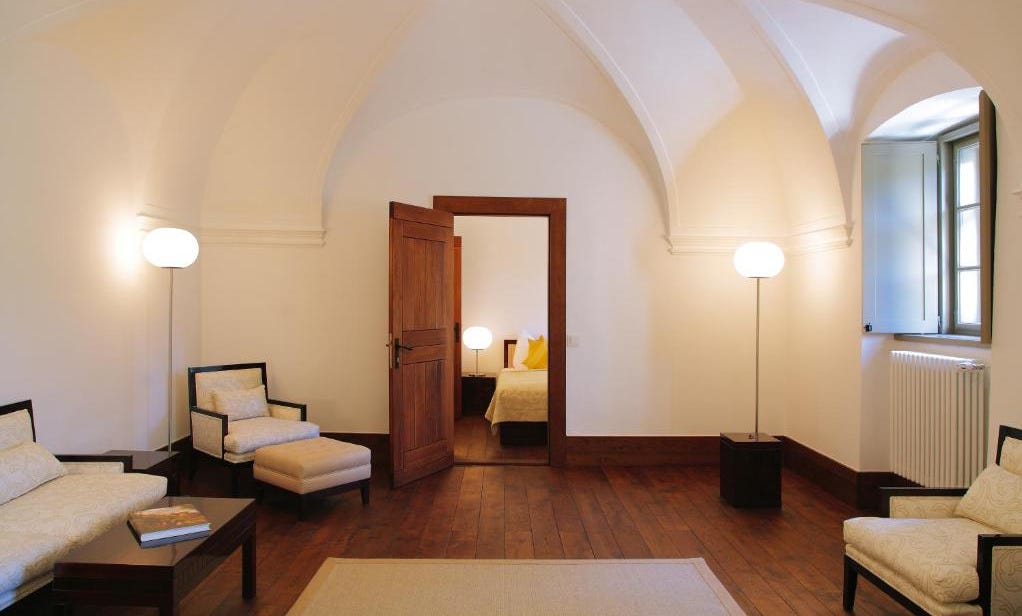
Despite my lack of Hungarian, and his limited English, I managed to conduct a conversation with the head waiter in the dining room at the former Carmelite monastery in the forests of Sopronbánfalva, a district in the city of Sopron, close to the Austrian border.
I was there for five days in a refurbished monk’s cell. Nuns were there until the 1950s, the early post-war years when the country became a satellite state of the Soviet Union. The sisters commissioned some of the lavish art found in the adjacent church, where the devil is portrayed with the features of Stalin in one particular painting. The monastery later became an asylum, and eventually fell into disrepair until the refurbishment began in the early 2000s. Much of this was conveyed by the waiter, who by the third evening was responding to my questions about Hungary - its culture, its politics, its longest-serving Prime Minister, Viktor Orbán. When asked his views on the country’s relationship with the European Union the waiter pressed his thumb hard on the table. Orbán describes himself as a rebel rather than a reformer, while retaining membership. Last year, the European Union's top court fined Hungary 200 million euros for its failure to adhere to the commission’s asylum policies, and issued a penalty of a further one million euros per day until it falls in line.
When I first informed the waiter I was from England and a native Londoner, he sighed. A response that was common to a number of his fellow countrymen during the fortnight I spent in Budapest, before making the three hour train and bus journey to the outskirts of Sopron and then to Pécs, close to the Croatian border, the following week. That sigh had become familiar among certain Americans and Europeans, witnessing Britain, a country admired internationally for an eternity, destroying itself from within. Or rather its institutions are destroying it, as the country’s citizens remain an enraged but silenced majority despairing at the failure to address immigration, the curtailing of free speech, and a two-tier approach to justice.
I’d had a similar experience on the train to Sopron, with an older man and his wife in a compartment reminiscent of that which Reggie Perrin used for his daily commute to ‘Sunshine Desserts’ in the 1970s. My fellow traveller was a septuagenarian, a native of Sopron. In the little English he had there was nothing but praise for his prime minister of fifteen years. He told me: ‘No wars! No migrants! No pride!’ I was thrown by the last one, and pushed him on this. He responded with an impression of someone with pursed lips, preening themselves. Pride.
Viktor Orbán has banned the pink parade, but the circus came to town along with sympathisers and supporters from abroad, two days after I left Hungary in late-June. Greta Thunberg put in an appearance, wearing a keffiyeh as a reminder of her failed attempt to reach Gaza by flotilla after being detained by the Israeli authorities. The leader of Dublin’s Green party was present at the Budapest rally, but even that didn’t make Orbán cower and reverse the decision. He responded to the spectacle of thousands marching across Liberty bridge with the following: ‘In 2022, 3.7 million Hungarians rejected what Pride promotes: pure gender propaganda. Anyhow, Brussels didn’t care - they ordered Pride anyway, and their allies in Budapest obeyed. This is the prototype. Migration, Ukraine - same script. Without a sovereign government, Hungary would be a puppet on Brussels’ string. We refuse to dance to their tune!’
The ban on LGBT parades was passed in March this year. Human rights groups are among the international bodies indignant at the introduction of legislation making it an offence to stage or attend events which ‘depict or promote’ homosexuality to those under the age of 18. This development, coupled with the official announcement, during his State of the Nation address in February, that there are only two genders, male and female, brought greater division between Hungary’s Prime Minister and the European Commission. The commissaries are bringing legal proceedings, claiming a potential breach of EU law and the rights of EU citizens.
The government’s critics believe it is exploiting ‘child protection’ by equating homosexuality with paedophilia. The government maintains its concern is with the physical, mental, and moral development of the young. There are flaws to both arguments, but this impasse is the fault of the trans lobby and the bandwagon many have jumped on in supporting it. This has muddied the waters and created division among those that were united in their efforts to campaign for equal rights. No doubt in Hungary, as in Britain, gay men and women have formed breakaway groups, to distance themselves from the vocal minority that has taken over the territory. While in the West, Pride is essentially homosexuality as Disney for conventional onlookers that have no skin in the game. I remember writing years ago about a British left-wing comedian who described the event as a day out for all the family. Thorpe Park and Alton Towers were the more obvious choice, I argued. Now I’m not so sure. It’s an industry, and one that panders to every tiresome caricature gay men and women once fought to overcome. Equally, many of the battles have been won in the territories where this charade is an annual event.
The countries lagging behind in making progress are never referred to by those rallying and marching. In fact, many protesters become apologists for them. The risible ‘Queers For Palestine’ clique summarises the deranged mindset of this disingenuous sub-cult. The changes fought for and won in Hungary meanwhile, remain. At least the ones that matter, I assume. That was the take away of this accidental tourist. As a man in his sixties, travelling solo, carrying a shoulder bag, and with a sibilant ‘S’ that arrived with the dentures in April, I encountered no animosity throughout my stay.
By banning Pride marches, along with illegal immigrants, Orbán sees himself tasked with preventing his country from becoming what Britain has transformed into. He has alluded to the role that mass immigration, multiculturalism, and sheep-like protesters in search of the cause du jour have played in bringing about its decline, intent on shattering Britain’s confidence, morale, and standing in the world.
At the monastery in Sopron, the head waiter at the ornate restaurant - the scenic religious paintings on the ceiling from which a grand and delicate chandelier is suspended, were rediscovered during the refurbishment - informed me that his prime minister had been a guest there three times in the previous five years. What did he do throughout his holiday?
In order to reach the monastery you arrive by car from Sopron, or the bus that pulls in every hour, after a twenty minute journey from the main station. There is the option of the walk, or rather climb to the monastery, via the ‘stairway of the saints’. The small town at the foot of the mountainous stairway has little of note beyond local houses, and a Spar. The chances of finding an English speaker here, even among the young, appears to be rare. In the absence of my Hungarian, I discovered two words that take on an Esperanto in these parts, when a native is providing directions to the nearest ATM: Lidl and Aldi.
The monastery greets you as you finally reach the top of the steps, on which the saints are stationed at certain points, having returned to their positions after a break during wartime. Hidden in the forest beyond, the Heroes Cemetery, where the calm and peacefulness in an enclosed field of crosses marking the men killed in the two world wars, has a silence to match that within the walls of the monastery.
There is breakfast. There is a three course meal in the evening. There is a library with modern desks and some antiquated texts. There are gardens. Beyond that there is silence within the white washed walls punctuated by the thick wooden doors to the former monks cells along the hallowed corridors where they, and later, nuns walked towards meals or prayers.
I didn’t watch films during my visit, but the ambience, the mood and the setting brought several to mind.
The eight guests at dinner, scattered about the dining room, avoiding the gaze of those outside their company, made me think of Kubrick’s The Shining. Walking the streets of the tiny town at the foot of the huge stairway on a pilgrimage towards a Lidl, or an Aldi, an ATM, made me think of William Burroughs seeking drugs in Mexico City, in Luca Guadagnino’s adaptation of the author’s novel Queer, which I streamed the week before in Budapest. Finally, Jack Nicholson taking on a dead man’s identity in Algiers, in Antonioni’s The Passenger.
On my third day, movement broke the tranquility and meditative mood that dominated my stay.
From early afternoon circular white tables and high white bar stools with low backs, were strategically placed throughout the garden, which my cell looked on to. Table lamps were added. A long buffet table appeared. Finally the apparatus for a DJ was assembled on a table covered by a white table cloth.
During dinner, guests began arriving in the garden and as the evening darkened, ambient music morphed into endless tracks that could rise to the middle reaches of the Eurovision scoreboard. No one danced. All the guest wore white. Before the party got started, myself and the head waiter watched from a dining room window. In the best way he could, and with some drawings on a serviette, he informed me it was a ‘white’ party, and that as a hotel guest I was entitled to free drinks and food if I wore white. I was equipped with a white shirt, trousers and underpants, but implied that I didn’t have the suitable wardrobe. My polite way of passing up the invitation. He turned to one of the ancient pieces of furniture that brought a Baronial splendour to the room, and pulled out a huge, crisp, flawless white linen table cloth, and laughed. Hinting at an outfit that was more Gandhi than Christ, despite the setting.
At the train station on my return to Budapest, Google translate broke through the language barrier, as the staff passed a phone back and forth, and we added our questions and answers in our native tongues. In the dining room at the monastery hotel and retreat centre the third day of my stay, humour broke through and brought us together, along with football. The waiter was an ardent fan. His knowledge of the landscape of the British Isles was mapped out by the names of major football teams. But there was also something deeper that united us, which he tried to relate. ‘Hungary, Austria, Germany, France, Italy, Britain’ - he delivered a shortlist of the names of countries, as though listing those taking part in Eurovision. Except his reasons were more poignant. There was an urgency to his voice. In the best way he was able, he explained that the people of these nations had more in common with each other than with those from which alien invaders were arriving, and bringing the destruction of the common culture, and the enemy within that was aiding and abetting this. As he pressed his thumb hard to the table earlier, to express the hold the European Union had over Hungary, he now clasped his hands tightly together. It was a gesture of solidarity, but he could have equally been bringing them together in prayer.
On leaving Sopron and returning to Budapest, before the trip to Pécs days later, it struck me that perhaps Viktor Orbán held a natural affiliation with monks and monasteries. Since 2019 the government headquarters has been housed in a former monastery high up on the Buda side of the Danube, where the castle and the majestic Fisherman’s Bastion look across to the stately parliament building in Pest.
This is one of a number of changes that occurred following my visit to Budapest nine years earlier. I arrived two months before the Brexit vote in Britain in 2016. News reached me that Victoria Wood had died during that visit, and the following day, as I took the train to Munich, Prince, of Paisley Park, Minnesota, had gone too.
During that trip I stayed in an apartment close to Budapest’s university library, and Cafe Central. Minutes from these is now a Scruton cafe, one of five outlets that emerged during my nine year absence as part of a tiny franchise seemingly more evident than Pret or Caffè Nero. On this trip I became a regular, joining others given the opportunity to spend a morning on a laptop, while nursing one cardamom chai latte. Named after the British philosopher Roger Scruton (1944-2020), Scruton cafes contain books and artefacts donated by his widow. Familiar Scruton quotes on his political outlook are found on walls and menus:
Conservatism is more an instinct than an idea………The conservative response to modernity is to embrace it, but to embrace it critically……..It's the instinct to hold on to what we love, to protect it from degradation and violence and to build our lives around it.
The country’s Prime Minister is one a number of high profile Hungarians that hold Scruton and his conservative or, perhaps traditionalist beliefs, in high esteem.
In the time that has elapsed between my trips to Hungary the standing of Viktor Orbán has shifted. While the waiter, along with the septuagenarian native of Sopron continue to support him, the younger people I encountered, a number of them baristas, harboured an animosity, declaring they would leave the country if he was voted in again. One was a young Hungarian woman who had taken a sabbatical in China, and been to Britain once, making it to a warehouse party in Camden during a holiday in Holland. She was intent on finding her way to Edinburgh and the home of J.K. Rowling, by way of a pilgrimage. The impact the Harry Potter books had on her as a child resonated even in her twenties.
The clamping down on Pride parades and other charges levelled concerning attacks on democracy, free speech and corruption, have activated their fear and loathing. Similar accusations are filed by pundits and columnists in Britain. But there are also many Britons that look to Hungary hoping a similar government will one day end the increasingly authoritarian Labour regime, by way of a ‘restoration’ rather than a ‘revolution’, as the historian David Starkey puts it. Not conservatism per se, but perhaps something similar that embraces modernity, but embraces it critically.
China Girl, with her love for Hungary, her loathing of its government, and her longing for the land of Harry Potter, is presumably unaware of his creator’s criticism of the transgender cult. Or maybe she overlooks it, the way some are able to overlook the unholy alliance that is Palestine and Pride. Whatever her grievances with her government, you can only hope that her generation do not dispense with everything it represents in order to embrace an idea of modernity.
Hungary, a landlocked country, has always been in a unique, often problematic position, fenced in from the sea and the ocean - Lake Balaton, the Danube provide some consolation - with a language of its own. At present the country remains unique as it challenges the orthodox cultural and political narrative that is creating havoc in other European countries. ‘We love the nation, we love the country, and we are proud of it,’ Viktor Orbán has said. ‘It’s not very much mainstream thinking, political thinking of today Western societies. But in Hungary, we are still very patriotic and Christian and committed to those values. Not in an ideological level, but on the streets every day.’


