2016: THE NEW THOMAS NEWTON
A conversation with Michael C Hall of Dexter and Bowie's Lazarus

Michael C Hall and I are comparing notes on all that has been done in the name of David Bowie since his death in January.
“Did you see the Lady Gaga tribute at the Grammys?” he asks, that familiar eyebrow raised. “The BBC Bowie Prom was far, far worse,” I reply. “I swear you could hear him turning in his grave when Amanda Palmer brought her baby on stage.”
Luckily, Hall missed it all — he was at home in New York. Now he’s in London for the Mercury prize, for which Bowie’s Blackstar was a contender, but not the winner. He performed the track Lazarus, the title of the off-Broadway musical in which he played the lead. It opens in London this month, which means the capital is his home until the new year.
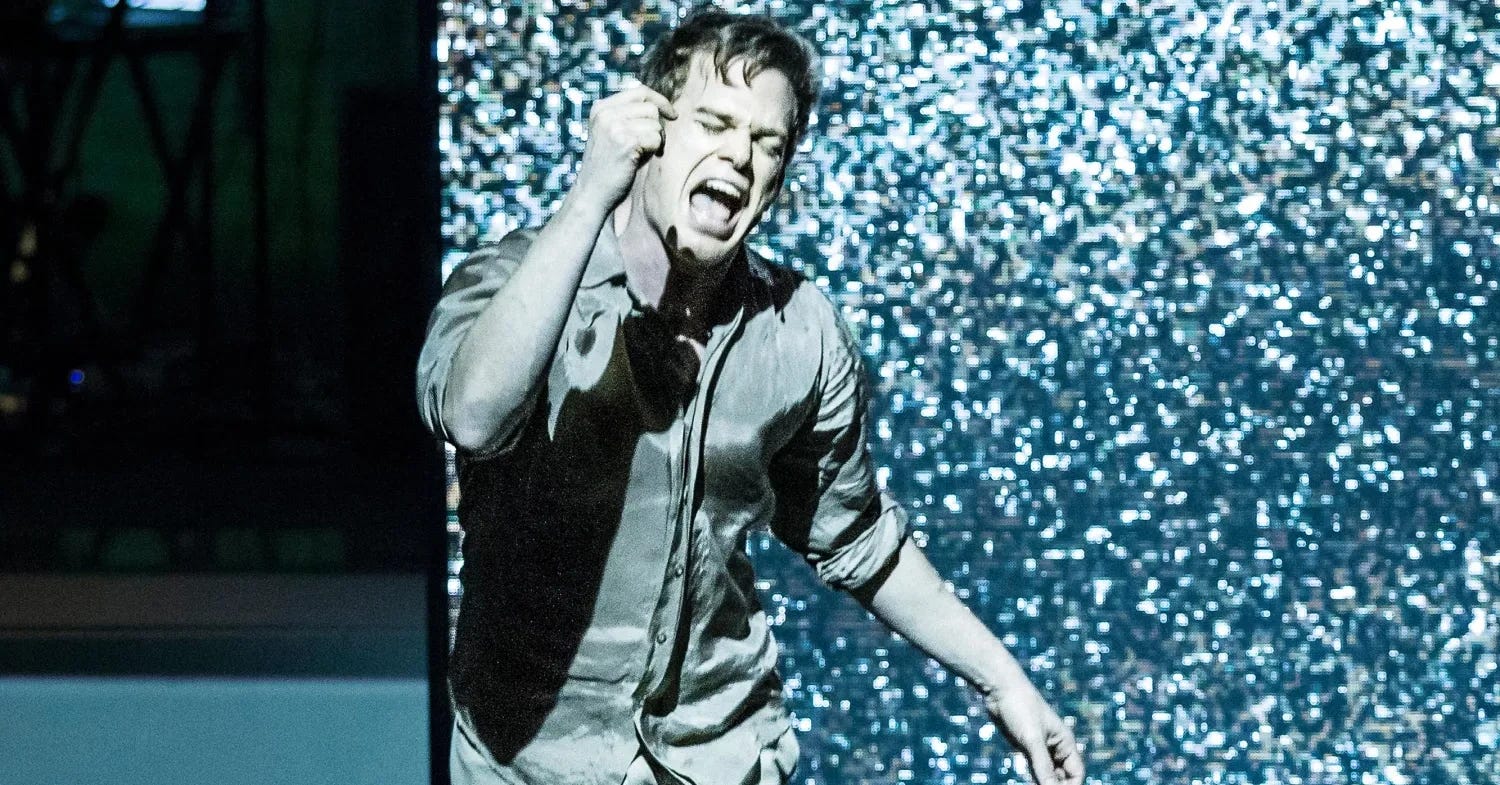
For the moment, Hall, 45, is Bowie’s representative on earth. The part of Thomas Jerome Newton in Lazarus was his from the start. He was cast on the back of his roles in the award-winning series Six Feet Under and the groundbreaking Dexter, rather than for Hedwig and the Angry Inch, the Broadway musical about an androgynous glam rocker in which, again, he played the lead.
At his Lazarus audition, Hall began with Where Are We Now?, the song that coaxed Bowie out of exile in 2013. “Meeting him and singing his songs felt like more than a formality,” he says. “David didn’t come to see Hedwig — he was aware of my acting, but that was the first time he heard me sing. I did puddle on the floor when he left, for a second.”
Musical theatre has been central to Hall’s stage career. His résumé also lists Cabaret and Chicago. Yet Lazarus is a departure, perhaps more akin to the avant-garde theatre work of Robert Wilson and Philip Glass. “The music doesn’t operate the way it does in traditional musical theatre, in as much as it isn’t always there to move the story forward. It can be atmospheric, but also provide a counterpoint. I know David didn’t want to do a jukebox musical, and this is the furthest thing from it.” Several songs from Bowie’s last two albums feature, along with three unreleased tracks and a surprising collection of rearranged numbers from the early years.
Of all the Bowie personas, Newton seems an unlikely one for him to return to. “He maintained a fascination with the character,” Hall says. “That theme of isolation and the interest in that embroidered interior world we all create runs through all his work. So to maintain he is not quite done with Newton makes sense.”
The character was the creation of Walter Tevis, author of the book that became the film The Man Who Fell to Earth, in which Bowie made his feature debut. The story was inspired by the trauma in the writer’s childhood when he was moved from his family in San Francisco to a children’s home. Transposed to film and fiction, it became the lonely travails of an alien landlocked on Earth, in the parched landscape of New Mexico.
Filming took place slap bang in the mid-1970s, when Bowie was at his lowest point with drugs and depression, but equally, scaling the summit creatively and stylistically. Reviews from the time mention his “imperial detachment” in the role. But was it a great performance, or merely a thin white drug-addled rock star going through the motions?
“Well, I don’t know that those things are mutually exclusive,” Hall says. “His performance is fascinating. He is disarmingly beautiful and impossible not to watch. I like that he doesn’t take pains to act otherworldly. He doesn’t need to.”
Forty years on, the Newton in Lazarus drinks gin, eats junk food and watches television. Little is revealed of the backstory of the intervening years. The orange hair and alabaster skin are absent, even though he doesn’t appear to have aged. According to the script, he’s “a dying man who cannot die”, retreating into his internal world and self-imposed exile.
Death has stalked Hall’s role choices: the gay, conservative undertaker David Fisher in Six Feet Under; the cold but cool forensics expert and serial killer Dexter Morgan. With Newton, the fundamental theme is grief — the loss of family, a longing for home.
According to Hall, the parts he plays tend to be “dichotomous”, something that is perhaps true of Bowie, too, who was both “impenetrable and revealing”, as Hall puts it. He brings a darkness and a humour to the roles. There was a muscularity to his Hedwig that also has parallels with Bowie. No matter how thick the make-up or how high the heels, Bowie somehow maintained a trace of blokey straightness.
Hall was never in a band, yet there is a touch of Jagger and the New York Doll David Johansen about his features. His vocals owe a debt to a 1970s rock voice, and his look today, as he sits in his publicist’s office in Covent Garden — scuffed boots and scruffy black — is the wardrobe of a rock singer in his forties. He’s reserved rather than guarded, cerebral rather than detached — perhaps one of those figures who spring to life when inhabiting a part. Or, as he corrects me, “becomes inhabited”. The word “repressed” recurs throughout his conversation.
As Bowie appealed to the loner and queer outsider that some of us were in adolescence, I wonder if this was Hall’s experience (certainly not now, as he’s on his third marriage). “I think I behaved in ways that were pretty conformist. My dad died when I was 11. I understood implicitly that I needed to take care of my mother. The best way was not to upset her, never cause her to unnecessarily worry about me. So I kept a lot under lock and key. I’ve certainly found myself working on things that have encouraged me to explore whatever is repressed or shadowy in me, and I’m glad.”
Hall’s father died at 39 of prostate cancer. In 2009, at 38, Hall was diagnosed with Hodgkin’s lymphoma, a cancer of the immune system. He announced he was fully in remission in 2010. But he was aware of death very early, as his sister died in infancy before he was born. The trauma of losing his father was “a frozen moment” he regularly returned to and slowly, gradually, pulled himself out of. Trauma and death are so much part of the characters he has played that, on meeting him, Bowie asked: “What is it with you?”
The day the cast were due to record the Lazarus album was the day Bowie died. Two days later, they were back on stage. “The recording gave us a chance to actively do something productive that we knew was in sync with his wishes. It was very emotional and surreal. Doing the show was more challenging, realising just how much David’s enthusiasm for it had to do with its capacity to be a meditation on mortality and death.”
One of the featured songs in the show is The Man Who Sold the World, from the album of the same name, released in the UK in 1971, the year Hall was born. When did the boy Michael come on board as a Bowie fan, growing up in North Carolina? Turns out it was the moment when many of us jumped ship: Let’s Dance.
“I saw this dashing, blond, tanned, moody crooner and went back from there and appreciated all the shape-shifting that had occurred. I steeped myself in the Bowie catalogue and revisited it a lot when Hedwig was happening. I was listening to Hunky Dory on a loop in my dressing room for a while. There were cutouts of him all over the mirror.”
As we prepare to leave, I say I was listening to Blackstar on the way to the interview. I had been thinking of the lyric from the song Dollar Days, in which Bowie mentions England. After many years, following his diagnosis, he made the trip here from his home in New York, and revisited settings that had been the backdrop to his formative years. Blackstar was his swan song; Lazarus the posthumous goodbye, and the fulfilment of an ambition to see his work staged as a musical. His last public appearance was at the New York opening.
“That’s so funny — I was thinking of those very same lyrics on the way here, too,” Hall says. It’s a moment of recognition in which he is suddenly alert, wide-eyed, smiling, emerging from the reserved, thoughtful figure of the past 40 minutes. “‘If I never see the English evergreens I’m running to,’” he quotes, “‘it’s nothing to me.’”
